Menachot 93a ~ The Relationship between Hearing and Intelligence (Yesterday’s Daf)

Not too far from where I live is Gallaudet University. It was founded in 1864 with a Charter signed by Abraham Lincoln. (And here’s a fun fact: to this day the diplomas of all Gallaudet graduates are signed by the presiding U.S. president.) Among its alumni are the actress Shoshanah Stern, the poet Dorothy Miles and Wilma Newhoudt-Druchen, a member of South Africa’s Parliament. Oh, I forgot to tell you. Gallaudet is a university for the deaf and hard-of-hearing. Which brings us to today’s daf.

In a discussion of who may perform the ritual act of semicha - laying hands on an animal before its sacrifice, the Mishnah lays down the following rules:

מנחות צג, א

הכל סומכין חוץ מחרש שוטה וקטן וסומא ועובד כוכבים והעבד והשליח והאשה

Everyone [who brings an animal offering] places their hands upon its head, except for a deaf-mute, an deranged person, a minor, a blind person, a gentile, a Canaanite slave, the agent of the owner of the offering who brings the offering on the owner’s behalf, and a woman.

The Talmud explains why the deaf are excluded: חרש שוטה וקטן דלאו בני דעה “a deaf -mute, a deranged person and and a minor are not mentally competent.”

This is a widespread legal principle that appears often in the Talmud. For example, this group of three are not required to appear in Jerusalem three times a year, they may not write a get, (bill of divorce) and they may not serve as a ritual slaughterer unless properly supervised.

Which raises the question - what have we learned about the relationship between intelligence and hearing?

The Rabbinic and the Roman

American Sign Language: “Deaf.” Touch your finger on your cheek near your ear, then move your finger in a small arch and touch it near the mouth. Start and end the sign on the cheek.

American Sign Language: “Deaf.” Touch your finger on your cheek near your ear, then move your finger in a small arch and touch it near the mouth. Start and end the sign on the cheek.

To better understand the rabbinic rulings about the deaf, we must put them into a historical context. “In the early law of Rome” wrote the historian Albert Gaw (from Gallaudet) over a century ago, “the deaf-mute from birth was considered incapable; he was classed with the madman and the infant; he was unable to perform without assistance any legal act in his own behalf.” Hmm. Sounds familiar? Gaw continues:

It is evident that the deaf and dumb would naturally be debarred from engaging in such formal and solemn acts as the making of stipulations, testaments, codicils, executory trusts, and donations mortis causa, at least so long as the ability to spéak or to understand speech was requisite for the performance of these acts. In like manner, the deaf and dumb would be unable to take part in adoptions, emancipations, solemn manumissions, and would be excused from the duties of guardianship as long as verbal formalities were required to give validity to these acts. Also because of their inability to speak and hear they would not be chosen to act as judges, arbiters, witnesses, or procurators. They would also be barred from solemn entrance upon an inheritance because of the necessity of repeating the prescribed formula at the time of entry, which for a person both deaf and dumb would be physically impossible. Even for persons adventitiously deaf who retained their speech some of the above named acts were prohibited, as a person who could not hear was held to be unable to carry out the letter of the law as to the repetition of the formula made imperative on pain of nullity. The solemn forms of marriage, confarreatio et coemptio, could not be complied with by persons who were deaf and dumb; neither could a deaf-mute buy and sell by the formal emptio venditio or mancipatio.

...the Romans did not consider deafness a separate phenomenon from mutism and... consequently, many believed all deaf people were incapable of being educated. Ancient Roman law, in fact, classified deaf people as ‘mentecatti furiosi’ which may be translated roughly as raving maniacs and claimed them uneducable.
— Elana Radutsky. The Education of Deaf People in Italy and the Use of Italian Sign Language. In Van Cleve (ed) Deaf History Unveiled. Gallaudet University Press 2002.p 239

Things got (a little) better under Emperor Justinian (527-565 CE). His code recognized different types of deafness and distinguished between them in law. Those deaf people who could write enough to conduct their daily affairs were granted legal rights.

Into the (Not so) Modern Age

The rights of the hard-of-hearing remained mired due to a lack of understanding about the nature of deafness, and an aversion to understanding their sign language. In fact, so strong was this aversion that at the infamous Milan conference of 1880, sign language instruction was banned. Banned. Instead, the members of the Second International Congress on the Education of the Deaf declared that oral instruction (lip-reading and speech) was to be used exclusively. Ignorance reigned supreme.

Alexander Graham Bell, (yes, he of the telephone) was one of those behind the Milan declaration. He later wrote a treatise “Upon the Formation of a Deaf Variety of the Human Race” in which he noted that many deaf people marry other deaf people. Sometimes these marriages produced children who were hard-of-hearing. Bell, the card-carrying eugenicist, found this unacceptable. And so in his paper (published by the National Academy of Sciences no less) he suggested outlawing the marriage of two deaf people. It’s enough to make you throw your phone across the room.

Research on the intelligence of the hard of hearing

In 1968 the psychologist McCay Vernon published a now classic paper “Fifty Years of Research on the Intelligence of Deaf and Hard-of-Hearing Children.” He pointed out the biases in IQ assessment of deaf children resulting from improper testing methods, research participant sampling, and even the experience level of the evaluators themselves. He reviewed 37 studies that measured the intelligence of samples of deaf and hard-of-hearing children performed between 1930 and 1965. Here are some of Vernon’s conclusions (but keep in mind that he was writing this in the 1960s, and our notions of the utility of standardized IQ tests as a measure of anything have evolved considerably since then.)

  • The communication problems of profound hearing loss, the attentive set of deaf children toward psychological examination, and other aspects of test administration rule out the validity of group intelligence testing.

  • Almost all of the investigations involved only samples of deaf children who were in school programs for the hearing impaired. This approach involved incomplete sampling and left unanswered the question of the intelligence of deaf children not in these schools.

  • The work done by investigators who were experienced in the psychological testing of deaf children at the time they did their work (see the notations in this table) yielded results showing the deaf and the hearing more nearly equal in intelligence. As the experience of the examiner has strong direct bearing on the validity of test results, these studies must be given special emphasis in any consideration of the relative intelligence of deaf and hearing children on IQ measures.

  • Based on an understanding of the disease conditions causing deafness, it is apparent that many of the etiologies of profound hearing loss are also responsible for other neurological impairment which frequently results in lower intelligence. “The point to be made is that the relationship, if any, between developmental delays and deafness is not causal but is due to the common etiology which brought about both the deafness and the developmental delay.”

  • These studies indicate that there is no relationship between degree of hearing loss and IQ or the age of onset of deafness and IQ.

In sum, the implication of the research of the last fifty years which compared the IQ of the deaf with the hearing and of subgroups of deaf children indicates that when there are no complicating multiple handicaps, the deaf and hard-of-hearing function at approximately the same IQ level on performance intelligence tests as do the hearing.
— McCay Vernon. Fifty Years of Research on the Intelligence of Deaf and Hard-of-Hearing Children: A Review of Literature and Discussion of Implications. Journal of Rehabilitation of the Deaf 1968: 1; 1–11,

On one of the most thorough reviews of the literature since the publication of Vernon’s paper is found in a book called “Deafness, Deprivation and IQ,” by Jeffrey Braden from the University of Wisconsin. It is a deep dive into the methodologies of intelligence tests, what they measure and what they don’t. Braden found that deafness has very little impact on non-verbal intelligence; the impact of deafness is simply to lower verbal IQs and not affect non-verbal IQs. Which is what you would expect. His analysis of all the data also revealed that deaf children with deaf parents have performance IQs that are above the mean for hearing people. Above it. (Alexander Graham Bell, did you get that message?)

In her 2003 paper What the Rabbis Heard: Deafness in the Mishnah Bonnie Gracer noted that

The ancient Jews did live amongst the ancient Greeks and Romans. It is therefore not surprising that the rabbis, as evidenced in the Mishnaic canon, incorporated into Jewish law Greco Roman beliefs linking hearing, speech, intelligence, and morality. It is clear, however, that the rabbis viewed all people, including deaf people, as unique individuals. The Mishnaic delineation of multiple categories of deafness resulted in not every deaf person being "categorically" disqualified or exempt from the performance of specific mitzvot. The rabbis observed deaf people, paid enough attention to notice detail, and deemed deaf people worthy of life, legal rulings, and protections. From the standpoint of deaf history, these are all extremely positive developments.

They are. But still not good enough.

On the Role of Science

In 1971 Rabbi Moshe Feinstein ruled that hearing aids would give a congenitally deaf person all the rights and obligations of one who hears normally. But five years earlier, in 1966, the great Torah scholar Yaakov Yechiel Weinberg published an article in the journal Hechal Shlomo about the religious rights and duties of a deaf Jew. He concluded by explaining that there were two approaches to this issue. Some rabbis believed deafness to be an organic deficit in the brain that also caused a degree of “mental handicap” (חסרון דעת) that remained despite any degree of education. Others believe that any degree of developmental delay was entirely due to a lack of adequate education. Consequently, once educated in school, the deaf were to be treated like any other Jew. Then he continued:

But we are not to rely on physicians or scientists to answer this question for us. For the measure of understanding required for a person to uphold mitzvot is entirely different for the rabbis than it is for scientists.
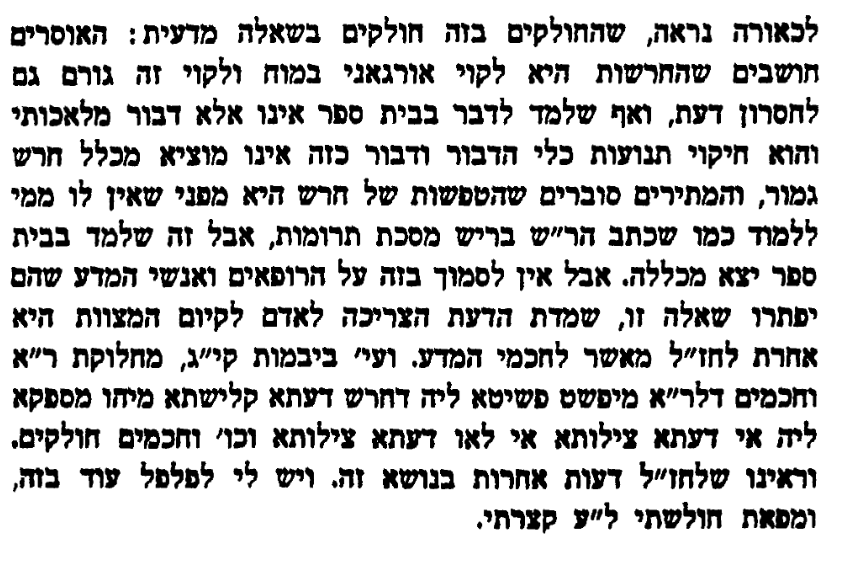
“הרב י.י. וינברג "חרש שלמד לדבר לחיוב מצוות. היכל שלמה שנה בשנה תשכ׳ה. 128

“הרב י.י. וינברג "חרש שלמד לדבר לחיוב מצוות. היכל שלמה שנה בשנה תשכ׳ה. 128

Rav Weinberg was of course correct: what is reality in halakha and what is reality in reality are often two very different things. But still, this was an unusual position to take, for as Marc Shapiro noted in his excellent intellectual biography of R. Weinberg, “the tendency to take into account modern social and educational issues is constantly present in his responsa.”Surely the religious status of a deaf person would be a test case for just that approach.

The Mishnah in today’s daf should make us uncomfortable. It raises many difficulties and challenges about the way Judaism once viewed - and often still does view - those with disabilities and people who were not free agents of their own time. The sages of the Mishnah and Talmud, influenced by cultural norms like those in ancient Rome, deemed the deaf not “mentally competent.” Two thousand years later, with the march of science we know that that this is factually incorrect. But you don’t need the science to tell you that. You just need to be lucky enough to know a deaf person.

Print Friendly and PDF

The 2026 Talmudology Passover Reader

Pesach starts on Wednesday evening.

In preparation, we are happy to share the 2026 Talmudology Pesach reader.

Download it and enjoy, and please stay safe and out of harm’s way.

אַחֵינוּ כָּל בֵּית יִשְׂרָאֵל
הַנְּתוּנִים בַּצָּרָה וּבַשִּׁבְיָה
הָעוֹמְדִים בֵּין בַּיָּם וּבֵין בַּיַּבָּשָׁה
הַמָּקוֹם יְרַחֵם עֲלֵיהֶם
וְיוֹצִיאֵם מִצָּרָה לִרְוָחָה
וּמֵאֲפֵלָה לְאוֹרָה
וּמִשִּׁעְבּוּד לִגְאֻלָּה
הָשָׁתָא בַּעֲגָלָא וּבִזְמַן קָרִיב
וְנֹאמַר אָמֵן

מִי שֶׁבֵּרַךְ אֲבוֹתֵינוּ אַבְרָהָם יִצְחָק וְיַעֲקֹב הוּא יְבָרֵךְ אֶת חַיָּלֵי צְבָא הֲגַנָּה לְיִשְׂרָאֵל, הָעוֹמְדִים עַל מִשְׁמַר אַרְצֵנוּ וְעָרֵי אֱלֹהֵינוּ מִגְּבוּל הַלְּבָנוֹן וְעַד מִדְבַּר מִצְרַיִם וּמִן הַיָּם הַגָּדוֹל עַד לְבוֹא הָעֲרָבָה בַּיַּבָּשָׁה בָּאֲוִיר וּבַיָּם. יִתֵּן ה’ אֶת אוֹיְבֵינוּ הַקָּמִים עָלֵינוּ נִגָּפִים לִפְנֵיהֶם. הַקָּדוֹשׁ בָּרוּךְ הוּא יִשְׁמֹר וְיַצִּיל אֶת חַיָלֵינוּ מִכָּל צָרָה וְצוּקָה וּמִכָּל נֶגַע וּמַחֲלָה וְיִשְׁלַח בְּרָכָה וְהַצְלָחָה בְּכָל מַעֲשֵׂה יְדֵיהֶם. יַדְבֵּר שׂוֹנְאֵינוּ תַּחְתֵּיהֶם וִיעַטְרֵם בְּכֶתֶר יְשׁוּעָה וּבַעֲטֶרֶת נִצָּחון. וִיקֻיַּם בָּהֶם הַכָּתוּב: כִּי ה’ אֱלֹהֵיכֶם הַהֹלֵךְ עִמָּכֶם לְהִלָּחֵם לָכֶם עִם אֹיְבֵיכֶם לְהוֹשִׁיעַ אֶתְכֶם: וְנֹאמַר אָמֵן:

Print Friendly and PDF

Menachot 70b ~ The Chemistry of Chametz

It is less than two weeks until Pesach, so it is time to talk about about unleavened bread, called chametz. Luckily, it comes up in today’s daf.

מנחות ע,ב

מנא הני מילי אמר ריש לקיש אתיא לחם לחם ממצה כתיב הכא (במדבר טו, יט) והיה באכלכם מלחם הארץ וכתיב התם (דברים טז, ג) לחם עוני 

והתם גופה מנלן אמר ריש לקיש וכן תנא דבי ר' ישמעאל וכן תנא דבי ר' אליעזר בן יעקב אמר קרא (דברים טז, ג) לא תאכל עליו חמץ שבעת ימים תאכל עליו מצות לחם עוני דברים הבאים לידי חימוץ אדם יוצא בהן ידי חובתו בפסח יצאו אלו שאין באין לידי חימוץ אלא לידי סירחון

Wheat close-up.JPG

How do we know that matzah must be made from one of five species of grain [wheat, barley, oats spelt and rye]?  Reish Lakish said, and likewise a Sage of the school of Rabbi Yishmael taught, and likewise a Sage of the school of Rabbi Eliezer ben Ya’akov taught, that the verse states: “You shall eat no leavened bread with it; seven days you shall eat with it matzah, the bread of affliction” (Deuteronomy 16:3). This verse indicates that only with regard to substances that will come to a state of leavening does a person fulfill his obligation to eat matzah by eating them on Passover, provided that he prevents them from becoming leavened. This serves to exclude these foods, i.e., rice, millet, and similar grains, which, even if flour is prepared from them and water is added to their flour, do not come to a state of leavening but to a state of decay [sirḥon].

The important question we need to answer here is whether there is something fundamentally different about rice when compared to the five grain species that can become chametz. And is there any scientific support to the claim that rice spoils sooner than it ferments?

The Chemistry of bread making

To get at the answers we need to remind ourselves how plants make and consume starch. They take carbon dioxide from the atmosphere and water from the soil, and using the energy contained in sunlight (and the magic of chlorophyll) convert the two into a large sugar molecule we call starch. Plants use this starch to store and provide them with energy.

If you grind up wheat (or many other species of grain) you make flour which contains loads of starch. In addition to starch, flour contains proteins and enzymes which become important when the flour is mixed with water. Without going down a rabbit-hole of detail, here in general is what happens. First, an enzyme called beta-amylase breaks the large starch molecule down into a smaller molecule called maltose which is made up of two molecules of glucose. Another enzyme, maltase, breaks down each molecule of maltose into two molecules of glucose which is then broken down further to provide the plant with energy. Here is what it looks like:

From Lloyd, James R and Kötting, Oliver (July 2016) Starch Biosynthesis and Degradation in Plants. John Wiley & Sons, Ltd: Chichester.

From Lloyd, James R and Kötting, Oliver (July 2016) Starch Biosynthesis and Degradation in Plants. John Wiley & Sons, Ltd: Chichester.

If you add some yeast into that mix, a chemical reaction called fermentation occurs. Yeast, which is a fungus, consumes glucose and turns it into carbon dioxide and ethanol, which is an alcohol.

Yeast and fermentation.png

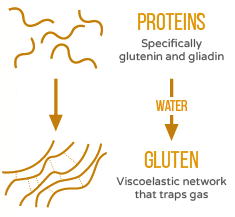
As the flour and water and yeast all mix together, two proteins in the flour called gliadin and glutenin (which are glutens) give the dough mixture its characteristic body, which strengthens the more it is mixed. The dough traps the carbon dioxide that is given off by the yeast cells, which causes the bread to rise. And that gives us the leavened bread we call chametz.

Proteins to Gluten.png

Of course when matzah is made, we do not add yeast to the dough. But there are yeast particles in the air and these will inevitably land on the dough where they will act in the same way, consuming glucose and creating carbon dioxide and alcohol. This process is much slower than when yeast is added when bread is made, but the plain dough will rise a little as a result.

The differences between grains and rice

Resh Lakish (together with those sages of the schools of Rabbi Yishmael and Rabbi Eliezer ben Ya’akov) claim that unlike grains, rice does not ferment when water is added to it. Instead it spoils. That’s why it may be eaten on Passover (unless of course you are an Ashkenazi Jew, in which case you still can’t eat it, but for another reason we’re not going to get into). Is this in fact the case?

I know next to nothing about plant biology. But Dr Angus Murphy does. He is Professor and Chair of the Department of Plant Science at the University of Maryland, and wrote the textbook on plant physiology. Dr. Murphy was kind enough to have a long chat with me over the phone and he agreed with the suggestion that grains and rice do very different things when mixed with water. The wheat seed is surrounded by the endosperm, which is itself covered by the aluerone layer. This aleurone is rich in amylase which as you recall is needed to breakdown starch into glucose (which is eaten by yeast which releases carbon dioxide and alcohol which causes the dough to rise…) However (most species of) rice do not contain this aleurone layer. So they have very little amylase, which means that it takes them a much longer time to convert starch into glucose. In fact it takes so long that by the time there is enough yeast in the dough for it to start to rise, bacteria in the air will have colonized the mixture and started breaking down the proteins in the dough. And that protein breakdown is what makes the mixture spoil, and which is what the Talmud calls סירחון. To conclude, Professor Murphy thought that the Talmud’s description of the difference between grain and rice was firmly based in plant biology.

The fine print and the final verdict

Distribution of variou types of amylases in rice grains. (Beta-Amylase activity was expressed in terms of maltose mg liberated in 3 min at 30°C by 1 g of ground rice samples.) From Ryu Shinke, Hiroshi Nishira & Narataro Mugibayashi. Types of Amy…

Distribution of variou types of amylases in rice grains. (Beta-Amylase activity was expressed in terms of maltose mg liberated in 3 min at 30°C by 1 g of ground rice samples.) From Ryu Shinke, Hiroshi Nishira & Narataro Mugibayashi. Types of Amylases in Rice Grains. Agricultural and Biological Chemistry 1973; 37:10, 2437-2438

Of course things are a little more complicated than that. (They always are.) Different kinds of wheat flour contain different amounts of amylase. Fine bleached white flour contains less amylase than say whole wheat flour, because the aleurone layer in whole wheat flour has not been broken down. Similarly, different species of rice contain different amounts of amylase, so that while standard white rice has very little, brown rice has considerably more. During talmudic times, the wheat flour would have been far less processed than any of the flour we would use today. As a result it would contain more amylase, and would have risen faster than would today’s four-water mixtures.

But as a rule of thumb, the Talmud is, biochemically speaking, spot on. When mixed with water, the five species of grain from which matzah may be made do undergo fermentation even without the addition of yeast, while rice will spoil long before the fermentation process becomes noticeable.

Print Friendly and PDF

Menachot 64b ~ Cursed Be He Who Raises Swine

Today we are going to talk about pigs. But before we get into it, here is some important background, courtesy of the Jewish historian of the first century, Josephus.

From here.

From here.

Following the death of their father Alexander Yannai in the first century B.C.E. two brothers, Hyrcanus and Aristobulus fought over which would ascend to the Hasmonean throne. Both appealed to Rome (which turned out to be a very bad idea) and in 63 B.C.E. the military leader Pompey turned up to sort things out. He backed Hyrcanus, who was the Cohen Gadol, (high priest) at the time, and who had been originally named as the heir. Pompey captured Aristobulus and took him off to Rome, and he let Hyrcanus remain as the Cohen Gadol. But Pompey refused to Hyrcanus become king. And that is how the Romans came to Jerusalem, or as Josephus put it “we lost our liberty, and became subject to the Romans.” OK. Now here is the relevant part in tomorrow’s Daf Yomi:

מנחות סד, ב 

תנו רבנן כשצרו מלכי בית חשמונאי זה על זה והיה הורקנוס מבחוץ ואריסטובלוס מבפנים בכל יום ויום היו משלשלין להן דינרין בקופה ומעלין להן תמידין היה שם זקן אחד שהיה מכיר בחכמת יוונית לעז להם בחכמת יוונית אמר להן כל זמן שעסוקין בעבודה אין נמסרין בידכם למחר שלשלו להן דינרין בקופה והעלו להן חזיר כיון שהגיע לחצי חומה נעץ צפרניו בחומה ונזדעזעה ארץ ישראל ארבע מאות פרסה על ארבע מאות פרסה באותה שעה אמרו ארור שיגדל חזיר וארור שילמד בנו חכמת יוונית ועל אותה שעה שנינו מעשה שבא עומר מגגות צריפין ושתי הלחם מבקעת עין סוכר

The Sages taught: When the kings of the Hasmonean monarchy besieged each other [in their civil war,] Hyrcanus was outside of Jerusalem, besieging it, and Aristoblus was inside. On each and every day they would lower dinars in a box from inside the city, and those on the outside would send up animals for them to bring the daily offerings in the Temple. A certain elderly man was there [in Jerusalem] who was familiar with Greek wisdom. He communicated to those on the outside by using words understood only by those proficient in Greek wisdom. The elderly man said to them: “As long as they are engaged with the Temple service, they will not be delivered into your hands.” Upon hearing this, on the following day, when they lowered dinars in a box, they sent up a pig to them. Once the pig reached halfway up the wall, it inserted its hooves into the wall and Eretz Yisrael shuddered four hundred parasangs by four hundred parasangs. When the Sages saw this, they said at that time: Cursed is he who raises pigs, and cursed is he who teaches his son Greek wisdom…

Alongside circumcision and Sabbath observance, the prohibition against pork is considered one of the clearest identifiers of what a Jew does and, as such, who is a Jew.
— Jordan Rosenblum. ‘Why Do You Refuse to Eat Pork?’’ Jews, Food, and Identity in Roman Palestine. The Jewish Quarterly Review 2011. 100 (1): 95–110

Pig Husbandry in Iron Age Israel - North vs SOuth

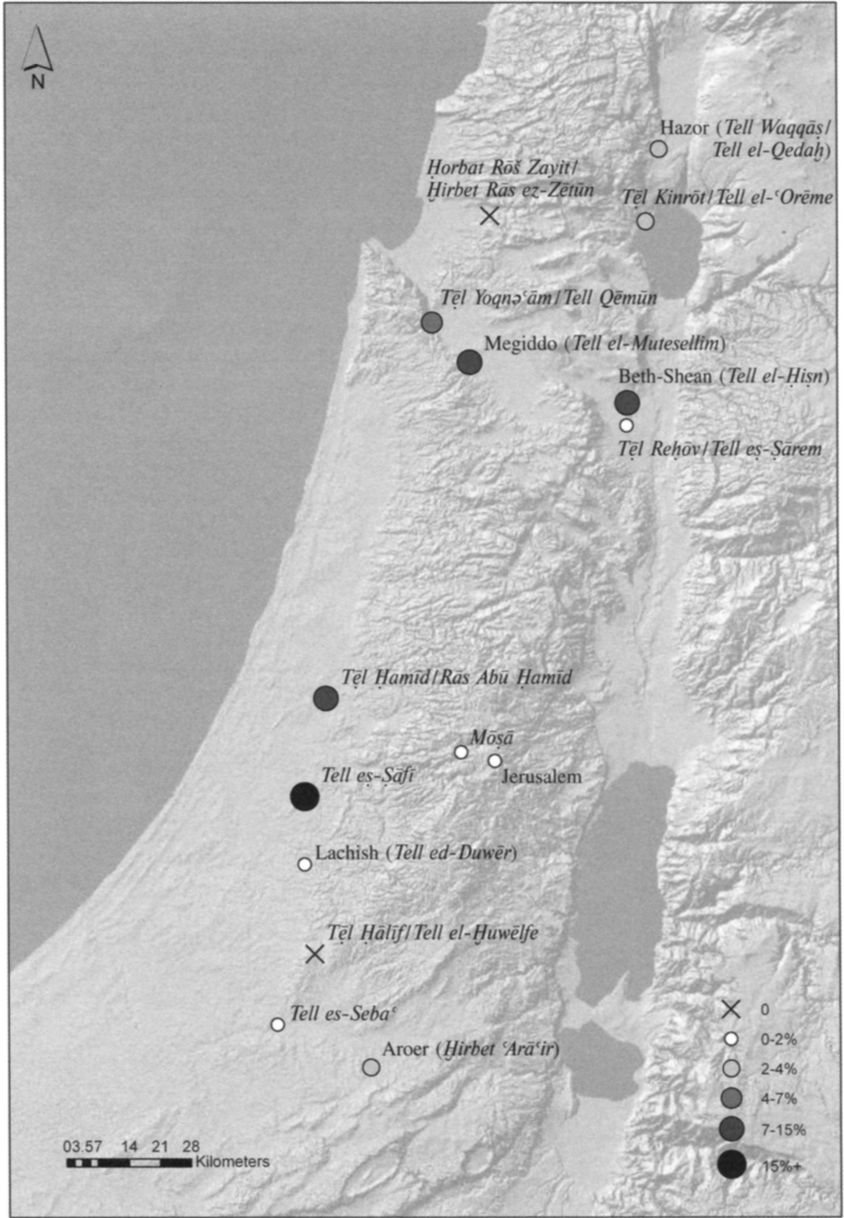
It has been long taken as a given that archeologists could use the presence (or absence) of pig remains to distinguish a Philistine from an Israelite settlement. For example, in known Philistine sites from Iron Age I (~950-780 BCE) like Ashdod and Ekron, pig bones account for 7-19% of the animal remains, depending on which strata you are excavating. This is a much higher percentage than is found in Israelite settlements of the same period. But in 2013 this assumption was challenged by a group of top-notch Israeli archeologists (including the controversial Israel Finkelstein) who reviewed the evidence for it. They studied data from 35 sites in Israel, and found a remarkable trend. In the territory of what was once the Northern Kingdom of Israel, pig remains account for 3-7% of all animal remains. But in the Southern Kingdom of Judah, pig remains are almost absent. (The site of Aroer is a bit of an anomaly, with more than 3% pigs. However this site seems to have been a rest stop for many international travelers and so may have served a more international cuisine.) There was a dichotomy between the kingdoms of Israel and Judah that was manifest in whether they ate pork.

Sapir-Hen, L. Bar-Oz, G. Finkelstein, I. Pig Husbandry in Iron Age Israel and Judah. New Insights Regarding the Origin of the "Taboo." Zeitschrift des Deutschen Palästina-Vereins (1953-), Bd. 129, H. 1 (2013), pp. 1-20.

Sapir-Hen, L. Bar-Oz, G. Finkelstein, I. Pig Husbandry in Iron Age Israel and Judah. New Insights Regarding the Origin of the "Taboo." Zeitschrift des Deutschen Palästina-Vereins (1953-), Bd. 129, H. 1 (2013), pp. 1-20.

Why was there a rapid rise in the frequency of pigs being eaten in northern Israelite sites during Iron Age II (the period between 870 and 680 BCE)? Among the answers proposed is that “the pig taboo could have been another Judahite cultural trait that was opposed to the situation in the north, and which the authors [of the Torah] wished to impose on the entire Israelite population.” Alternatively, it may have been a result of the larger population found in the Northern Kingdom of Israel. “This process” wrote the authors of the paper Pig Husbandry in Iron Age Israel and Judah “brought about shrinkage of the open areas that are important for sheep/goat husbandry, and could have forced the Iron Age IIB population to a shift in meat production, breeding smaller herds of sheep and goats and concentrating more on pigs, which could supply large and immediate sources of meat.” In contrast, the population of the Kingdom of Judah was much smaller than that of Israel. Hence they had more open space to raise livestock.

By the way, it was the Philistines who were responsible for importing European type pigs into the Middle East. Dr Merav Meiri of the Department of Zoology at Tel Aviv University analyzed the DNA of ancient pigs in the area, and found that they possessed a European gene signature. This raises the possibility that European pigs were brought to the region by the Sea Peoples who migrated to the Levant around 900 BCE, bringing their pigs with them.

Pigs & Ancient Rome

Whether or not pigs were eaten in some parts of Biblical Israel, there is no doubt that not eating pork became synonymous with Jewish practice. In Rome, things were different. There, eating pork was widespread and enjoyed, and it was one of the most common meats associated with its residents. And as Jordan Rosenblum points out in his 2010 paper Why Do You Refuse to Eat Pork?’’ Jews, Food, and Identity in Roman Palestine swine were one of the four most common animals used for sacrifices in Rome. It was used in the most sacred rite of the Roman religion known as the suovetaurilia, in which a pig, a sheep and a goat were sacrificed to Mars, as part of a ceremony consecrating the land to the gods. According to the Roman philosopher Epictetus “the conflict between Jews and Syrians and Egyptians and Romans, [was] not over the question whether holiness should be put before everything else and should be pursued in all circumstances, but whether the particular act of eating swine’s flesh is holy or unholy.”

Our Passage in the Talmud Yerushalmi

In the Jerusalem Talmud, there is a similar description of the story told in tomorrow’s Daf Yomi, with an important difference. Can you spot it?

תלמוד ירושלמי (וילנא) מסכת ברכות פרק ד

א"ר לוי אף בימי מלכות רשעה הזאת היו משלשלין להן שתי קופות של זהב והיו מעלין להם שני כבשים ובסוף שלשלו להן ב' קופות של זהב והעלו להם שני חזירים לא הספיקו להגיע לחצי חומה עד שנעץ החזיר בחומה ונזדעזעה החומה וקפץ מ' פרסה מארץ ישראל באותה שעה גרמו העונות ובטל התמיד וחרב הבית

R. Levi said: ‘‘Also during the days of that Evil Empire [Rome], they would lower to them two baskets of gold and they would send up to them two lambs. At the end [of the siege], they lowered to them two baskets of gold and they sent up to them two pigs. They did not reach halfway up the wall when the pig stuck [its nails] in the wall and the wall shook and [the pig] jumped forty parasangs from the land of Israel. At that moment, the sins brought about both the suspension of the continual offering and the destruction of the Temple.

Here is the difference: in the Yerushalmi version the substitution of the pig for the lambs is directly linked to the destruction of Jerusalem, and not just to a general ban on the raising of pigs. “Rome’s secret weapon in times of war with the Jews” wrote Rosenblum, “is to deploy the very animal that functions as a metonym for Rome itself.”

So pigs turn out to have played more of a role in our history than would be expected. In biblical times, eating pork may have been a marker of whether you came from Israel or Judea, and pork, or at least its symbolism, played a pivotal role in the onset of the Roman attack on the Second Temple.

Archaeologists take pigs very seriously.
— Israel Finkelstein cited in "Who’d Import Pigs to Israel? Ancient Europeans, Researchers Say." New York Times Nov 5, 2014. A7.

Next time on Talmudology: The Chemistry of Chametz.

Print Friendly and PDF