Genetics

Chullin 47b ~ Red Babies, Green Babies, and other Neonatal Colors

חולין מז, ב

Green Baby.jpg

רבי נתן אומר פעם אחת הלכתי לכרכי הים באתה אשה אחת לפני שמלה בנה ראשון ומת שני ומת שלישי הביאתו לפני ראיתיו שהיה אדום אמרתי לה בתי המתיני לו עד שיבלע בו דמו המתינה לו ומלה אותו וחיה והיו קורין אותו נתן הבבלי על שמי

ושוב פעם אחת הלכתי למדינת קפוטקיא באתה אשה לפני שמלה בנה ראשון ומת שני ומת שלישי הביאתו לפני ראיתיו שהיה ירוק הצצתי בו ולא היה בו דם ברית אמרתי לה בתי המתיני לו עד שיפול בו דמו המתינה לו ומלה אותו וחיה והיו קורין אותו נתן הבבלי על שמי

 Rabbi Natan says: Once I went to the cities overseas, where one woman came before me who circumcised her first son and he died, and she circumcised her second son and he died, and out of concern that circumcising her third son might cause him to die as well, she brought him before me. I saw that he was red, so I said to her: My daughter, wait for him until his blood is absorbed into him. She waited for him until his blood was absorbed into him and then circumcised him, and he survived. And they would call him Natan the Babylonian after my name. 

Rabbi Natan further related: And on another occasion I went to the state of Cappadocia, and a woman came before me who circumcised her first son and he died, and she circumcised her second son and he died. Out of concern that circumcising her thirds on might cause him to die as well, she brought him before me. I saw that he was green. I looked at him and saw that he did not have the blood of circumcision in him, [i.e., he had a deficiency of blood such that no blood would emerge from the circumcision]. I said to her: My daughter, wait until his blood enters him. She waited for his blood to increase and then circumcised him, and he survived. And they would call his name Natan the Babylonian after my name.

Hemophilia A
Normal father carrier mother.jpg

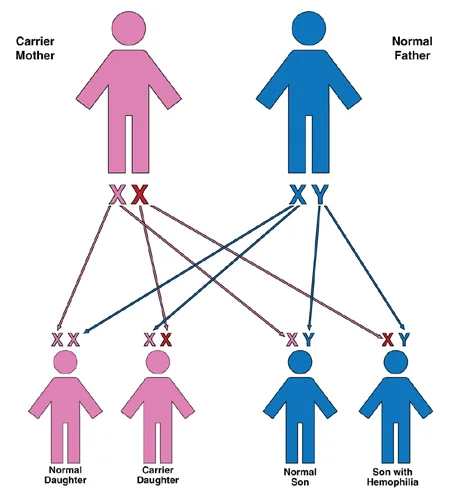
We have had several occasions in the past to review cases similar of baby boys and the dangers of circumcision, most recently when we studied Chullin 4a and its relation to Hemophilia A. But this is the first time there is a discussion of skin color. Rabbi Natan describes a red looking baby boy and a green looking baby boy. Since in each case there were siblings who had died under similar conditions, it is reasonable to assume that these cases too were caused by hemophilia A. Rabbi Natan’s babies survived because they did not have two copies of the gene for hemophilia. Instead they carried only one copy of the gene which is the cause of this disease. It is a mutation in the F8 gene,which controls the manufacture of Factor VIII, a key component of the clotting cycle. You can see this in the diagram (showing a normal father and carrier mother.) Only half the boys will (on average) become hemophiliacs.

However, there are alternative suggestions, which do not ascribe these colors to hemophilia alone. Let’s start with…

The Red baby boy

In his classic work התלמוד וחכמת הרפואה -The Talmud and Medicine (Berlin 1928, p231-2), I.L Katzenelsohn claimed that the red baby disease is erythema neonatorum. His family also carried hemophilia (because his two brothers had bled to death after their circumcisions), but this third baby was also red. Erythema (toxicum) neonatorum is a common finding in newborns and is thought to be due to an immune reaction (though to what remains unknown). It is a benign condition, and needs no treatment. Rabbi Natan believes that a presumption of what we call hemophilia can only be made once it has been seen three times. This had not yet happened (two previous brothers had died, not three) and so he ordered that the brit can go ahead once the redness cleared up. Luckily, the boy was only a carrier of hemophilia (he was heterozygous for the F8 gene), and so he survived the circumcision.

Others are not so sure what this redness indicated. “I have no idea to what the rabbis are referring to" wrote Dr. Abraham Abraham (that’s his real name, not a typo,) in his work on medical halacha נשמת אברהם, The Soul of Avraham (יורה דעה 263:3). He was a Professor of Medicine at Hebrew University and Hadassah Medical School, so if he is stumped I guess we all are. So now let’s turn to…

The Green Baby Boy

This one is really hard to figure out, because there isn’t agreement on precisely what is meant by the description that the baby is ירוק, green. Rashi describes it as “the color of grass” which is - at least in the summer - a nice green color. Tosafot, being Tosafot, disagrees, and suggests that it is a sky blue color. And even more colors appear in later halachic works.

Katzenelsohn believed the “green” color is more of a yellow one, which is common in neonatal jaundice. (“Where is the best place to kook for neonatal jaundice?” I was asked as a medical student. “Um, the sclera?” I offered in reply. “Nope said the doctor, happily pimping me, “in the parking lot, - where the sun provides the best illumination.” But I digress). Neonatal jaundice is an almost universal finding in newborns, and results from a breakdown of the fetal hemoglobin that is no-longer needed now that the baby is ex-utero. Julius Preuss (Biblical-Talmudic Medicine, Jason Aronson 1978 p167) believes the green color does not mean green, but instead it means pale. In this reading the baby was anemic, meaning that it lacked hemoglobin.

And what would the green-is-really blue suggestion of Tosafot indicate? Well, blue skin is called cyanosis, and results from too-little oxygen reaching the tissues. The feet and toes of newborns are often blue for a couple of days, as they develop their own oxygen carrying capacity (having spent nine happy months relying on mom’s). Some of the things that cause peripheral cyanosis include the cold (that’s when your arteries no-longer want to shunt warm blood to your freezing fingers), heart failure (the heart is too tired to pump oxygenated blood to the peripheries) or chronic lung disease (the lungs just can’t get enough oxygen through them and into the bloodstream). Central cyanosis is usually much more serious. It can be caused by infections like pneumonia (and did I mention that it was a defining feature of impending death during the Great Influenza Pandemic of 1918?) In the context of a newborn, it may indicate congenital heart disease. Some forms of congenital heart disease are fatal, but today there are a number of operations (or sometimes several) that can save the neonate’s life.

The Overarching Principle of Brit Milah

Whatever the color of the little baby boy or the number of brothers who may have died as a result of circumcision, Jewish law has evolved from these descriptions in the Talmud to a position that is clear and absolute.

שולחן ערוך יורה דעה רס’ג, א

באלו הדברים שאין מלין ולד שיש בו חשש חולי דסכנת נפשות דוחה את הכל שאפשר לו למול לאחר זמן ואי אפשר להחזיר נפש אחת מישראל לעולם

In all of these conditions in which we do not circumcise the baby because of the risk of a fatal outcome, the circumcision is postponed to a later date [when the child is now healthy]. For it is possible to postpone the day of circumcision, but it is impossible ever to replace the soul of a Jewish baby.

Print Friendly and PDF

Chullin 47b ~ Red Babies, Green Babies, and other Neonatal Colors

חולין מז, ב

Green Baby.jpg

רבי נתן אומר פעם אחת הלכתי לכרכי הים באתה אשה אחת לפני שמלה בנה ראשון ומת שני ומת שלישי הביאתו לפני ראיתיו שהיה אדום אמרתי לה בתי המתיני לו עד שיבלע בו דמו המתינה לו ומלה אותו וחיה והיו קורין אותו נתן הבבלי על שמי

ושוב פעם אחת הלכתי למדינת קפוטקיא באתה אשה לפני שמלה בנה ראשון ומת שני ומת שלישי הביאתו לפני ראיתיו שהיה ירוק הצצתי בו ולא היה בו דם ברית אמרתי לה בתי המתיני לו עד שיפול בו דמו המתינה לו ומלה אותו וחיה והיו קורין אותו נתן הבבלי על שמי

 Rabbi Natan says: Once I went to the cities overseas, where one woman came before me who circumcised her first son and he died, and she circumcised her second son and he died, and out of concern that circumcising her third son might cause him to die as well, she brought him before me. I saw that he was red, so I said to her: My daughter, wait for him until his blood is absorbed into him. She waited for him until his blood was absorbed into him and then circumcised him, and he survived. And they would call him Natan the Babylonian after my name. 

Rabbi Natan further related: And on another occasion I went to the state of Cappadocia, and a woman came before me who circumcised her first son and he died, and she circumcised her second son and he died. Out of concern that circumcising her thirds on might cause him to die as well, she brought him before me. I saw that he was green. I looked at him and saw that he did not have the blood of circumcision in him, [i.e., he had a deficiency of blood such that no blood would emerge from the circumcision]. I said to her: My daughter, wait until his blood enters him. She waited for his blood to increase and then circumcised him, and he survived. And they would call his name Natan the Babylonian after my name.

Hemophilia A

Normal father carrier mother.jpg

We have had several occasions in the past to review cases similar of baby boys and the dangers of circumcision, most recently when we studied Chullin 4a and its relation to Hemophilia A. But this is the first time there is a discussion of skin color. Rabbi Natan describes a red looking baby boy and a green looking baby boy. Since in each case there were siblings who had died under similar conditions, it is reasonable to assume that these cases too were caused by hemophilia A. Rabbi Natan’s babies survived because they did not have two copies of the gene for hemophilia. Instead they carried only one copy of the gene which is the cause of this disease. It is a mutation in the F8 gene,which controls the manufacture of Factor VIII, a key component of the clotting cycle. You can see this in the diagram (showing a normal father and carrier mother.) Only half the boys will (on average) become hemophiliacs.

However, there are alternative suggestions, which do not ascribe these colors to hemophilia alone. Let’s start with…

The Red baby boy

In his classic work התלמוד וחכמת הרפואה -The Talmud and Medicine (Berlin 1928, p231-2), I.L Katzenelsohn claimed that the red baby disease is erythema neonatorum. His family also carried hemophilia (because his two brothers had bled to death after their circumcisions), but this third baby was also red. Erythema (toxicum) neonatorum is a common finding in newborns and is thought to be due to an immune reaction (though to what remains unknown). It is a benign condition, and needs no treatment. Rabbi Natan believes that a presumption of what we call hemophilia can only be made once it has been seen three times. This had not yet happened (two previous brothers had died, not three) and so he ordered that the brit can go ahead once the redness cleared up. Luckily, the boy was only a carrier of hemophilia (he was heterozygous for the F8 gene), and so he survived the circumcision.

Others are not so sure what this redness indicated. “I have no idea to what the rabbis are referring to" wrote Dr. Abraham Abraham (that’s his real name, not a typo,) in his work on medical halacha נשמת אברהם, The Soul of Avraham (יורה דעה 263:3). He was a Professor of Medicine at Hebrew University and Hadassah Medical School, so if he is stumped I guess we all are. So now let’s turn to…

The Green Baby Boy

This one is really hard to figure out, because there isn’t agreement on precisely what is meant by the description that the baby is ירוק, green. Rashi describes it as “the color of grass” which is - at least in the summer - a nice green color. Tosafot, being Tosafot, disagrees, and suggests that it is a sky blue color. And even more colors appear in later halachic works.

Katzenelsohn believed the “green” color is more of a yellow one, which is common in neonatal jaundice. (“Where is the best place to kook for neonatal jaundice?” I was asked as a medical student. “Um, the sclera?” I offered in reply. “Nope said the doctor, happily pimping me, “in the parking lot, - where the sun provides the best illumination.” But I digress). Neonatal jaundice is an almost universal finding in newborns, and results from a breakdown of the fetal hemoglobin that is no-longer needed now that the baby is ex-utero. Julius Preuss (Biblical-Talmudic Medicine, Jason Aronson 1978 p167) believes the green color does not mean green, but instead it means pale. In this reading the baby was anemic, meaning that it lacked hemoglobin.

And what would the green-is-really blue suggestion of Tosafot indicate? Well, blue skin is called cyanosis, and results from too-little oxygen reaching the tissues. The feet and toes of newborns are often blue for a couple of days, as they develop their own oxygen carrying capacity (having spent nine happy months relying on mom’s). Some of the things that cause peripheral cyanosis include the cold (that’s when your arteries no-longer want to shunt warm blood to your freezing fingers), heart failure (the heart is too tired to pump oxygenated blood to the peripheries) or chronic lung disease (the lungs just can’t get enough oxygen through them and into the bloodstream). Central cyanosis is usually much more serious. It can be caused by infections like pneumonia (and did I mention that it was a defining feature of impending death during the Great Influenza Pandemic of 1918?) In the context of a newborn, it may indicate congenital heart disease. Some forms of congenital heart disease are fatal, but today there are a number of operations (or sometimes several) that can save the neonate’s life.

The Overarching Principle of Brit Milah

Whatever the color of the little baby boy or the number of brothers who may have died as a result of circumcision, Jewish law has evolved from these descriptions in the Talmud to a position that is clear and absolute.

שולחן ערוך יורה דעה רס’ג, א

באלו הדברים שאין מלין ולד שיש בו חשש חולי דסכנת נפשות דוחה את הכל שאפשר לו למול לאחר זמן ואי אפשר להחזיר נפש אחת מישראל לעולם

In all of these conditions in which we do not circumcise the baby because of the risk of a fatal outcome, the circumcision is postponed to a later date [when the child is now healthy]. For it is possible to postpone the day of circumcision, but it is impossible ever to replace the soul of a Jewish baby.
Print Friendly and PDF

Bava Basra 110a ~ Uncles and Nephews

בבא בתרא קי, א

אמר רבא הנושא אשה צריך שיבדוק באחיה ... תנא רוב בנים דומין לאחי האם

Ravah said: If a man wants to marry a women he should examine the character of her brothers...It was taught in a Baraita: Most sons resemble their maternal uncles.

In today's page of Talmud we continue a discussion of the rights of inheritance, which evolves into a discussion of the influence that ancestors have over their descendents.  The Baraita (a collection of teachings from the era of the Mishnah)  cited in support of Ravah's advice notes that not all sons resemble their maternal uncles, but most do.

Shared Genetic Material

The amount of material we share with our relatives varies by the relationship.  Only identical twins share all of their genetic material.  We share 50% of our genes with each of our parents, and 50% with each of our siblings.  But as you can see below, we share only 25% of our genetic material with our uncles or aunts - the same amount we share with our grandparents.

Image from here.

Image from here.

The amount of genetic material we share with our uncles or aunts does not vary with whether they are on our maternal or paternal side. A boy will no more genetically resemble his maternal uncle than they will his paternal uncle.  And for girls, the rule is the same regarding their aunts.

We find this statement repeated in the Jerusalem Talmud, where it appears as part of a lengthy list originally stated by Abba Shaul:

תלמוד ירושלמי קידושין פרק ד

אבא אוריין איש צדיין אומר משום אבא שאול כו'. רוב חמרים רשעים. רוב גמלין כשירין. רוב ספנים חסידים. רוב ממזירין פקחין. רוב עבדים נאים. רוב בני אבות בויישנים. רוב בנים דומין לאחי האם כשר שברופאים לגיהנם. הכשר שבטבחין שותף עמלק

Most donkey drivers are evildoers, most camel drivers are upright, most sailors are pious, most Mamzerim are cunning, most slaves are haughty, most people of fine genealogy are embarrassed [to take from the public charity fund], most sons are like their uncles [i.e. their mother's brothers], the best doctors go to hell; the best butcher is a partner of Amalek... 

When understood in this context, the connection between uncles and nephews is nothing more than a pithy generalization, and about as likely to be correct as the others on the list.  Like all talmudic aphorisms, it was uttered in a different time and place from our own. If you really want to know who your child will resemble, you should look no further than you and your spouse.  That will be the most likely predictor of your child's character, whether genetically encoded or socially constructed.  

Print Friendly and PDF

Bava Kamma 77b ~ Pig x Sheep

בבא קמא עז, ב – עח, א

ואמר רבא זה בנה אב כל מקום שנאמר שה אינו אלא להוציא את הכלאים ...אמר לך ר"א כי איתמר דרבא לטמא שנולד מן הטהור ועיבורו מן הטמא...וטהורה מטמאה מי מיעברא אין דקיי"ל דאיעבר מקלוט 

Rava said this establishes a model and teaches that wherever the term שה [seh] is stated in the Bible, it is meant to exclude a hybrid... R. Eliezer would say to you  - when did Rava state his model?  With respect to a non-kosher animal that was born from a kosher mother and a non-kosher father...But can a kosher animal conceive from a non-kosher animal? Yes, for it has been established that this case refers to a kosher animal that was conceived from a [kosher mutant animal that was] born with uncloven hooves. (Bava Kamma 77b-78a)

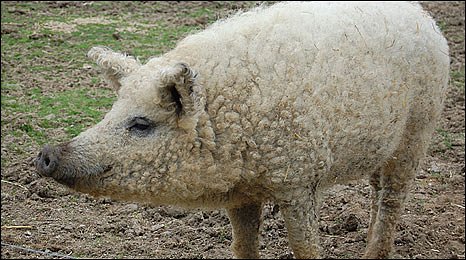
A pig in sheep's clothing? Nope. Just a pig.

A pig in sheep's clothing? Nope. Just a pig.

In toady's page of Talmud we read of a debate regarding the crossbreeding of different species, and the possibility that a non-kosher animal (say, a pig) could fertilize a kosher animal (like a sheep). Here the Talmud seems to suggest that this could not happen, and that when this possibility is raised, it refers to a kosher animal that is breeding with another kosher animal but which looks non-kosher because of a mutation that causes it to have non-cloven hooves. Here is that case:

k= kosher; m= mutant, born with non-cloven hooves

k= kosher; m= mutant, born with non-cloven hooves

This debate is part of a larger one found in another tractate of the Talmud, Bechorot. Here is part of that discussion:

בכורות ז, א

והאמר ר' יהושע בן לוי לעולם אין מתעברת לא טמאה מן הטהור ולא טהורה מן הטמא ולא גסה מן הדקה ולא דקה מן הגסה ולא בהמה מן חיה ולא חיה מן בהמה חוץ מר' אליעזר ומחלוקתו שהיו אומרים חיה מתעברת מבהמה וא"ר ירמיה דאיעבר מקלוט בן פרה ואליבא דרבי שמעון

...R. Yehoshua ben Levi said: A non-kosher female can never conceive from a kosher male, nor a kosher female from a non-kosher male, nor a large animal from a small animal, nor a small animal from a large animal, nor a domesticated animal from a non-domesticated animal, nor a non-domesticated animal from a domesticated animal, except for R. Eliezer and his disputant [in Chulin 79b], who claimed that a non-domesticated animal can conceive from a domesticated animal...(Bechorot 7a)

Which leads to the question of the day: Can a kosher animal indeed successfully breed with a non-kosher animal? Let's take a look.

When a pig loves a sheep

Pigs have been known to act, well, like pigs, and copulate with sheep. (There's even a video of it, if you are interested). But could this lead to a baby peep, or ship, or whatever you'd like to call it? There are pictures that suggest this may be so, but in actual fact this pig with wool is the rare Hungarian Mangalitza pig, and has no sheep ancestry.  

At the beginning of the twentieth century, Foster Dwight Coburn, a farmer who also served as the secretary of the Kansas Department of Agriculture published Swine in America; a text-book for Breeder, Feeder and Student, and on page 63 he made the following observation: 

There exists in some sections of Old Mexico a type of “hog” represented as the product of crossing a ram with a sow, and the term “Cuino” has been applied to this rather violent combination. The ram used as a sire to produce the Cuino is kept with the hogs from the time he is weaned. A resident of Mexico has given the following description of the Cuino: “The sow used to produce the Cuino belongs to any race, but as a rule to the Razor-Back family, which is the more numerous. There is never any difficulty with her accepting the ram when breeding time comes. The progeny is a pig—unmistakably a pig—with the form and all the characteristics of the pig, but he is entirely different from his dam if she is a Razor-Back. He is round-ribbed and blocky, his short legs cannot take him far from his sty, and his snout is too short to root with. His head is not unlike that of the Berkshire. His body is covered with long, thick, curly hair, not soft enough to be called wool, but which nevertheless he takes from his sire. His color is black, white-black, and white-brown and white. He is a good grazer and is mostly fed on grass with one or two ears of corn a day, and on these he fattens quickly. The Cuino reproduces itself, and is often crossed a second and third time with a ram. Be it what it may, the Cuino is the most popular breed of hogs in the state of Oaxaca, and became so on account of their propensity to fatten on little food.”

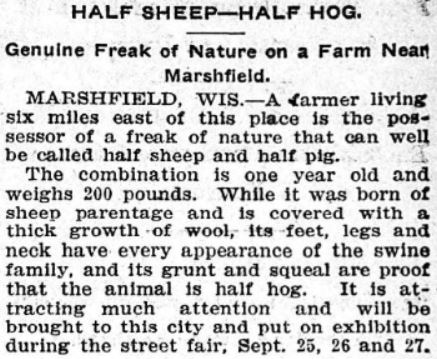
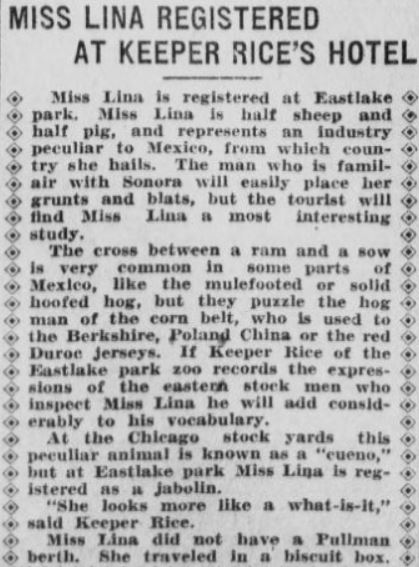
It may have been the most popular pig breed in Oxaca, but it was still rather an oddity in the US; newspapers found them interesting, as evidenced by two reports, from 1902 and 1908 about sheep-pig hybrids.  

The Minneapolis Journal, September 24, 1902, from here.

The Minneapolis Journal, September 24, 1902, from here.

Los Angeles Herald. October 3, 1908, from here.

Los Angeles Herald. October 3, 1908, from here.

Species and interbreeding

Despite these reports, it would seem that the rule suggested by R. Yehoshua ben Levi is correct. Different species cannot successfully interbreed, because, well, because that's the definition of a species, as the Oxford English Dictionary makes clear:

A group of living organisms consisting of similar individuals capable of exchanging genes or interbreeding. The species is the principal natural taxonomic unit, ranking below a genus and denoted by a Latin binomial, e.g., Homo sapiens.

So although it is a tautology, you get the idea: a species by definition can only breed with other members of its own species. If a pig and a sheep could breed and have offspring, they'd be members of the same species. But they are not. Pigs belong to genus Sus, and the species Scrofa, whereas sheep belong to the genus Ovis and the species Aries. Pigs have 38 chromosomes, and sheep have 54.  So they cannot cross-breed.  (Lions and tigers both have 38 chromosomes, so they can cross breed, and produce a liger.)

But it's not as simple as that.  Even if you don't have the same number of chromosomes, you can still sometimes breed outside your species. Horses have 64 chromosomes and donkeys have 62. Yet they can cross breed, resulting in a mule (if mom was a horse) or a hinny (if mum was a donkey), although these are nearly always sterile. Horses belong to the genus Equus and the species ferus, and donkeys belong to the same genus but to a different species, africanus.  Yet they can interbreed.  Which raises the question: should a horse and a donkey be re-classified as belonging to the same species? But that would be odd, because they look so different and act in very different ways.

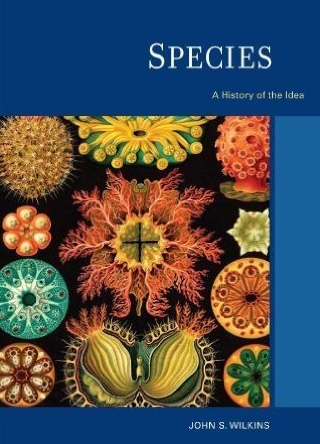
These kinds of questions  are perplexing, and have challenged the world of biology since the time of Carl Linnaeus (d. 1778) who gave the world a way of categorizing and naming all living things called binomial nomenclature. Briefly it goes like this: the grey wolf belongs to the genus Canis and the species lupus.  Dogs belong to the same genus, Canis, and are a subspecies of wolves, so their scientific name is Canis lupus familiaris (which I suppose makes it a trinomial nomenclature).  We belong to the genus Homo and the species sapiens, whereas chimpanzees belong to a different genus and species, Pan troglodytes. Anyway just what gets a creature into one species class or another is a really challenging question, one that is still being played out in the scientific literature. There's even a 320 page book from the University of California Press in which the author "provides a new perspective on the relationship between philosophical and biological approaches" to the concept of a species. For now, though, R. Yehoshua ben Levi's generalization found in Bechorot is pretty close to the Linnaean taxonomy we use today.  We can also conclude that the general rule of the Talmud from today's daf, that a kosher animal could not successfully breed with a non-kosher one, is a pretty good rule of thumb.

Every living thing loves its like,
and every person his own sort.
All creatures flock together with their kind.
— Ecclesiasticus, 13:15.

 Next time on Talmudology: Is garlic good for you? 

Print Friendly and PDF